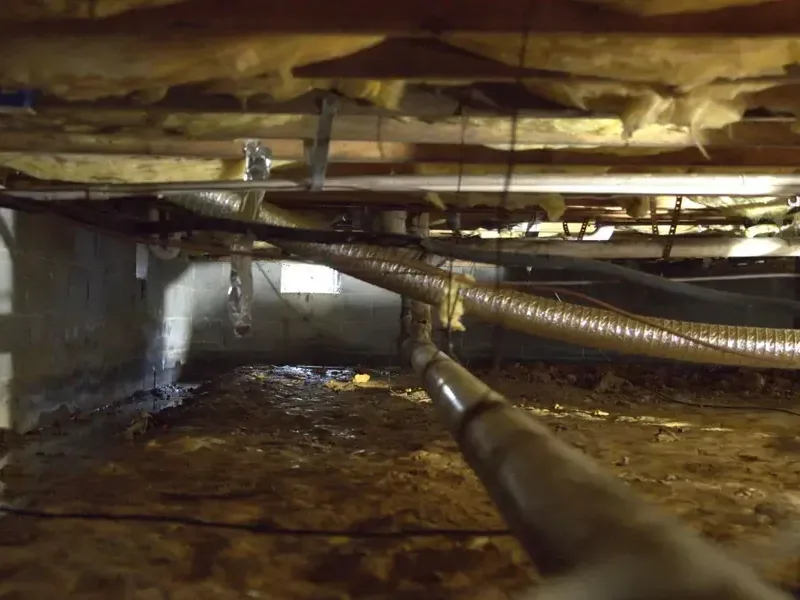
Mean daily minimum temperatures in Broomfield stay below freezing from November through March, reaching 18.3 F in January and 18.0 F in December. That is the stretch when a pipe in an unheated space can freeze, split and leak long before anyone sees a stain.
Key takeaways
- Broomfield sits in USDA hardiness zone 6a, with an average annual extreme minimum of -9.4 F.
- A frozen pipe can split without a sound, and the leak often starts only after the pipe thaws.
- Open one faucet and warm a frozen pipe slowly; never use a torch or an open flame.
- Know where the main water shutoff is before the first hard freeze.
- After a thaw, check the walls, ceilings and floors near the frozen pipe for damp drywall or staining.
What Broomfield winters do to plumbing
Broomfield has a cold semi-arid climate. Its USDA plant hardiness zone is 6a, and the average annual extreme minimum is -9.4 F.
From November through March the daily low stays under freezing. A hard freeze in that stretch can reach plumbing that is exposed or sits in an unheated space.
Water expands as it freezes, and the pipe is what gives way. The split can be small, but the water behind it is under pressure.
That pressure is why a tiny crack can soak a wall cavity in a short time once the ice melts.
Most of the damage happens quietly. A pipe can freeze overnight, split under the pressure and stay sealed by ice until the afternoon sun or the heating brings it back to life.
Where pipes freeze first
Cold finds the weak spots in a house, usually the parts the heating does not reach well. Knowing those spots is half the defense.
Wind makes it worse. A gap around a pipe that enters an exterior wall can let cold air blow straight onto the metal, even when the room looks warm.
- Pipes inside exterior walls.
- Pipes in a garage or any other unheated room.
- Pipes under a sink on an outside wall, where a closed cabinet door traps the cold.
- Outdoor spigots and the short pipe behind them.
Warning signs before a pipe splits
A pipe that is freezing often gives a signal before it fails. Catching it early can save a wall.
A pipe may show none of these signs, which is why a cold snap calls for a walk through the house. Check the garage, the cabinets on outside walls and any room that was left unheated.
- A faucet that runs slowly or not at all on a cold morning.
- Frost on a visible pipe.
- A bulge or a crack in the pipe.
- A new damp spot on a wall or ceiling near a pipe run.
What to do with a frozen pipe
A frozen pipe is a problem to handle carefully, because rushing it can turn a frozen pipe into a flood. The steps below are the same ones the frozen pipe water damage crew follows before any cleanup begins.
Warm it slowly
Open the faucet so melting ice has a place to go. Warm the pipe with a hair dryer or warm towels, working from the faucet back toward the frozen section.
Never use a torch or an open flame.
Know when to stop
If the frozen pipe is inside a wall, leave it alone. Shut off the main, and let a plumber and the restoration team deal with it.
What not to do
Do not force a frozen faucet open with a tool, and do not pour boiling water over a pipe. Sudden heat can crack a pipe that survived the freeze.
- Do not use a propane torch or an open flame.
- Do not leave a space heater running unattended near wet areas.
- Do not ignore a pipe that stays frozen after warming; call a plumber.
After the thaw: finding the split
A pipe that froze may have split, and water pours out once the ice melts. Burst pipe water damage is often found as a damp ceiling below a bathroom, a wet cabinet base or a stain on drywall.
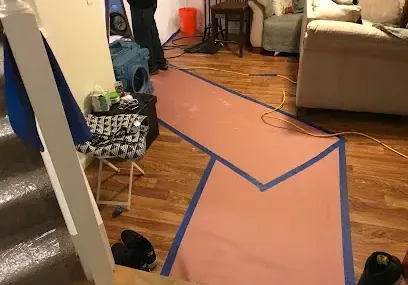
The restoration team extracts standing water, opens wet drywall where needed and dries the cavity with air movers and dehumidifiers.
Not every split shows right away. A leak in an exterior wall can run for days behind drywall before a stain appears, which is why the cavity is tested with a moisture meter.
If the water came from a hidden pipe, the plumber and the restoration team often work in parallel. One stops the leak while the other starts getting the water out of the structure.
- Shut off the main as soon as water is seen.
- Photograph the wet areas before anything is moved.
- Check the floor below and the wall behind the frozen pipe.
- Keep wet materials until the adjuster has seen them.
How drying finishes the job
Water that reached a wall cavity does not leave on its own. Structural drying follows extraction and brings framing, subfloor and drywall back to dry readings before any repair is closed up.
The crew logs the readings each day and compares them with a dry reference. Repairs start only when the numbers match.
Skipping this step is a common reason for a second repair. Drywall that looks fine on the surface can stay damp inside the cavity and cause paint to peel or stains to return.
Getting ready before the first hard freeze
A little preparation in October is cheaper than a ruined ceiling in January. The local pages on water damage in Broomfield cover each problem in more detail.
Households that travel in winter have the most to gain from a plan. A neighbor with a key and a shutoff location written on a card can turn a flooded house into a minor repair.
- Find the main shutoff and make sure it turns.
- Disconnect garden hoses and shut off outdoor spigots.
- Open cabinet doors on the coldest nights so warm air reaches the pipes.
- Let a faucet drip on the coldest nights.
- Keep the heat on if the house will be empty.
Questions
At what temperature do pipes freeze?
Pipes freeze when the air around them stays below freezing long enough, and wind or an unheated space speeds that up. A pipe in an exterior wall can freeze before one in the middle of the house.
Will a frozen pipe always burst?
No. Some pipes freeze and thaw with no damage, but ice expands, and a split is possible. That is why the walls and ceilings are checked after a thaw.
Should the main be shut off if a pipe is frozen?
If water is leaking, yes. If the pipe is only frozen, shutting off the main limits what pours out when it thaws.
Is a split pipe a plumbing job or a cleanup job?
Both. A plumber repairs the pipe, while the restoration team extracts the water and dries the walls and floors.
Why do leaks show up only after the thaw?
Ice plugs the split while it is frozen. Water runs out once the ice melts, often behind a wall where it is not seen right away.
What should be checked after a very cold night?
Run each faucet and look for slow flow, then look at ceilings, cabinet bases and exterior walls for new stains. A cold room that is warm again may be hiding a split behind a wall.