Structural Drying and Dehumidification in Erie, CO
Drying a building is not the same as drying the carpet. In Erie, the drying team sizes LGR dehumidifiers and air movers to the loss and logs readings daily until framing, subfloor and concrete reach a dry reference, 24/7.
(888) 532-8620Schedule moisture mapping and drying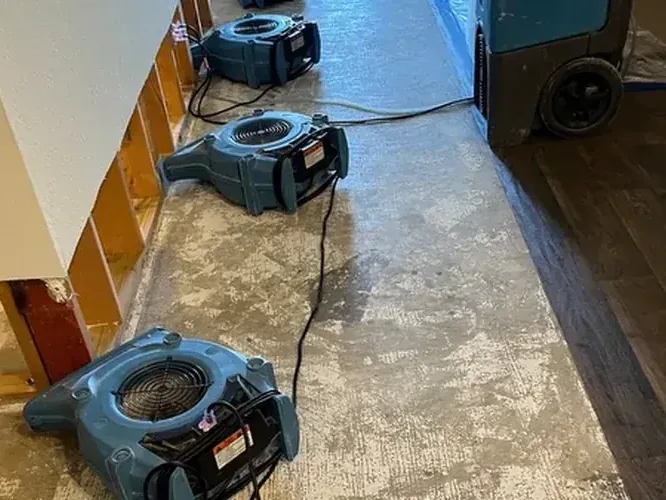
First steps for structural drying and dehumidification
- Get the water out.Extraction comes first, because drying cannot remove standing water.
- Leave equipment running.Keep air movers and dehumidifiers on, even at night.
- Keep the space closed.Keep doors and windows shut unless the drying team says otherwise.
- Let the readings decide.Equipment comes out when the numbers say dry.
How structural drying and dehumidification is handled, step by step
- 1
Map and classify
Moisture map and loss class set the plan.
- 2
Place equipment
Air movers and LGR units go in by room.
- 3
Log daily
Readings track progress every day.
- 4
Verify dry
Equipment leaves at the drying goal.
What does structural drying and dehumidification cost in Erie, CO?
Structural drying here typically runs $1,200 to $9,500. Dense materials or a Class 4 loss can reach $9,500 to $22,000 or more, depending on the square footage, the material class, the water category and how fast drying started.
One to two rooms
- Air movers and one dehumidifier
- Two to four days of drying
- Daily readings
Whole level
- Several LGR dehumidifiers
- Cavity drying
- Daily psychrometric logs
Dense materials or Class 4
- Hardwood, plaster or concrete
- Desiccant drying
- Extended monitoring
Ranges are typical, not a quote: the category of water, the square footage, the material class and how fast drying started move the number most. Run the water damage cost calculator for a closer planning range.
How a drying plan is built
Structural drying is the part of water damage restoration that decides whether problems come back. Wet framing, subfloor and drywall can look dry on the surface while holding water inside, and that hidden moisture is what warps floors and stains walls weeks later.
The walkthrough tech maps moisture with pinless and pin meters and thermal imaging, then classifies the loss. Class 1 is a small area with little absorption; Class 4 means dense materials such as hardwood, plaster or concrete that hold water deeply. The class sets how many air movers and dehumidifiers go in.
- Air movers: pull moisture out of surfaces into the air.
- LGR dehumidifiers: remove that moisture from the air.
- Desiccants: used for dense Class 4 materials and cool basements.
Drying in a dry climate still needs control
Front Range air is often dry outside, but a wet basement holds humid air that stalls drying. The drying team keeps the space closed and controlled rather than opening windows, so the dehumidifiers can do their work at a steady rate.
When drying is finished
Equipment stays until wet materials read within 2 to 4 points of a dry reference material in the same building. Daily psychrometric logs record temperature, humidity and moisture readings, which gives the adjuster a clear record of how and when the structure dried.
Further reading: Ready.gov flood safety and EPA WaterSense.
Structural drying and dehumidification across Erie and nearby towns
Nearby coverage reaches Lafayette, Frederick, Broomfield, Louisville, Longmont, Dacono, Firestone and Superior.
The restoration team covers ZIP 80516, from the older houses of Old Town around Briggs Street out along County Line Road to the newer subdivisions between Highway 7, Highway 52 and the I-25 frontage.
Related water damage services
Structural Drying and Dehumidification questions in Erie
What is structural drying?
Drying the building materials themselves, including framing, subfloor, drywall and concrete, to a measured goal rather than just drying surfaces.
How long does structural drying take?
Most losses dry in three to five days. Dense Class 4 materials such as hardwood or concrete can take longer.
Why not just open the windows?
Outside air conditions change hourly. A closed, dehumidified space dries at a steady, measurable rate.
What does 2 to 4 points of a dry reference mean?
The drying team reads an unaffected material in the same building and treats wet materials as dry when they read within 2 to 4 points of it.
Can I turn the equipment off at night?
Leave it running. Turning equipment off slows drying and can let moisture settle back into materials.
Need the structure dried properly?
Hidden moisture in framing and subfloor causes damage weeks later. The drying team dries it to a measured goal, 24/7.
(888) 532-8620Set up LGR drying for the structure