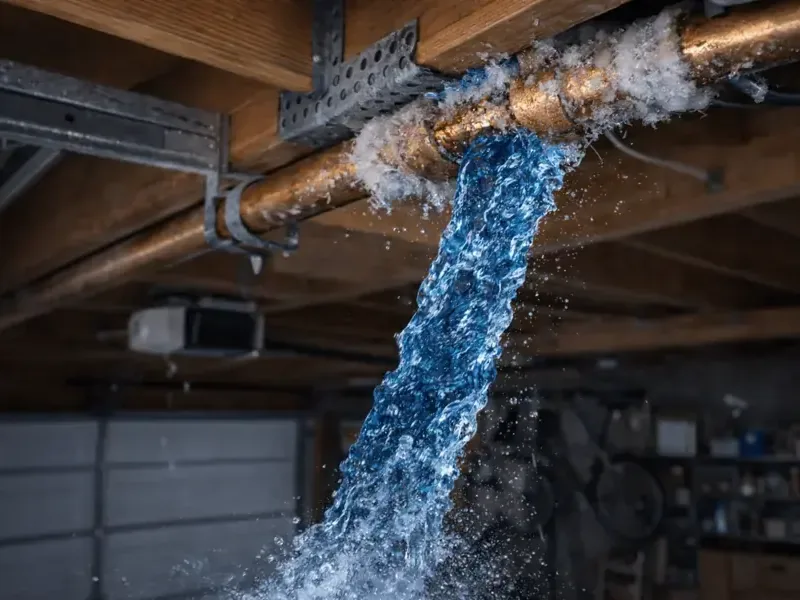
Erie started in 1867 as a coal town, and the mines that built it left empty rooms under parts of the ground. When that ground settles, the pipes that bring water in and carry sewage out can break, and the first sign is often water where none belongs.
Key takeaways
- Abandoned room-and-pillar coal workings sit 50 to 150 feet deep under parts of town.
- Subsidence can break water and sewer pipes and pull a basement away from the structure.
- Standard homeowners insurance does not cover mine subsidence, so the policy should be read before a claim is assumed.
- A broken supply pipe sends clean water at first, while a broken sewer pipe means contaminated water from the start.
- Cleanup follows the same steps whatever the cause: stop the water, extract it, remove what cannot be cleaned and dry the structure to a reference.
A coal town above empty workings
The town was settled in 1867 as a coal town and incorporated in 1874. Old Town Erie and Briggs Street remain the historic core.
The coal mines closed by 1960, and the Eagle Mine closed in 1978. Abandoned room-and-pillar workings, 50 to 150 feet deep, still lie under parts of town.
Room-and-pillar workings leave open rooms between columns of coal. When the ground over them moves, everything buried in that ground moves too.
This history is not a warning about every house. It is a reason to treat unexplained water, new cracks and sagging ground as questions worth asking early.
- 1867: settled as a coal town.
- 1874: incorporated.
- 1960: coal mines closed.
- 1978: the Eagle Mine closed.
What subsidence does to a house
Ground movement is slow, but the damage it does inside a building can be sudden. Pipes and basement walls feel it first.
A slow leak from a buried pipe can saturate the soil around a foundation for months. By the time water appears indoors, a good deal of damage may already be hidden.
Pipes break first
Subsidence can break water and sewer pipes where the ground drops under them. A break in a buried pipe may leak for a long time before anything shows inside.
Swelling and collapsible soils add to the movement, so a mine is not always the cause of a break.
Basements can pull away
Subsidence can also pull a basement away from the structure above it. A gap, a new crack or a door that suddenly sticks is a reason to have the pipes checked.
None of these signs proves a mine is involved, but together they justify a closer look by a plumber.
Signs that a pipe broke underground
A broken pipe in the ground rarely announces itself. These signs usually show up in the house first.
No single sign settles the question. A sprinkler, a running toilet or a dripping faucet can raise a bill too, so the pattern across several signs matters more than any one clue.
- A water bill that rises with no change in how the household uses water.
- A damp patch on a basement wall or floor that appears on a dry day.
- The sound of running water when every fixture is off.
- A sewage smell near a floor drain or in a lower level.
- Slow drains in more than one fixture at once.
The first hours after a suspected break
Once water or sewage shows, the order of steps matters more than speed. Each one protects the next.
If sewage is involved, the room is treated as contaminated until it has been cleaned and treated. Boots, gloves and a closed door keep the problem from spreading to clean rooms.
- Shut off the water main if a supply pipe is suspected.
- Stop using sinks, toilets and the washer if sewage is rising.
- Photograph the water, the wet walls and every stained surface.
- Move belongings out of the wet area if it is safe to do so.
- Keep children and pets away from any water that smells like sewage.
Supply pipe or sewer pipe: two different cleanups
The first question after a break is what kind of water is on the floor. The answer sets the whole plan.
Whatever the source, the aim is the same. Stop the spread, take out the water and give the structure a chance to dry before anything is rebuilt.
A broken water supply pipe
Water from a supply pipe starts clean. Shut off the main, then bring in burst pipe water damage help so the water is extracted before it wicks into drywall and framing.
The restoration team maps the moisture, opens the walls that are wet and dries the cavity.
A broken sewer pipe
Sewage is contaminated from the start. Porous materials it touched are removed, not dried, and hard surfaces are cleaned and treated, which is the work of sewage backup cleanup.
The Town utility bill carries sewer charges, and questions about which section of pipe belongs to whom go to the Town and a plumber.
What cleanup covers, and what it does not
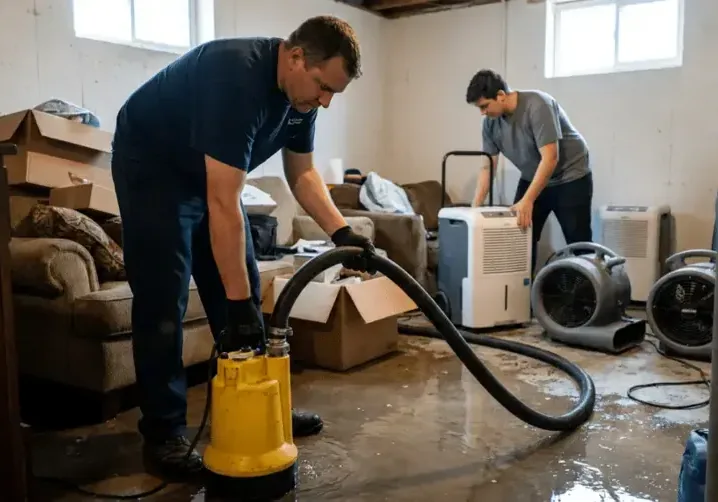
When a broken pipe floods a basement, basement flooding cleanup handles the water, the wet materials and the drying.
Cleanup does not repair the pipe, the foundation or the ground. Those repairs belong to a plumber and, where the structure moved, a structural professional.
A cleanup crew also writes down what it finds. Moisture readings, photos of removed materials and a daily drying log become part of the record if the cause of the break is questioned later.
- Shutting off the water and extracting what is standing.
- Removing wet carpet, pad, insulation and drywall that cannot be saved.
- Cleaning and treating hard surfaces after sewage.
- Drying framing and concrete with air movers and dehumidifiers, with daily readings.
Insurance and records when the cause is the ground
Standard homeowners insurance does not cover mine subsidence, which makes the cause of the break matter. The plumber's findings and the restoration team's photos should both be kept.
Read the policy for any added coverage, and ask the insurer before work that changes the evidence. A short written timeline of what was seen and when helps every later conversation.
- The plumber's invoice and any written finding about the broken pipe.
- Dated photos from the day the water or sewage was found.
- Moisture readings and the daily drying log.
- A short timeline of what was seen, when and by whom.
Questions
Does Erie have mines under houses?
Abandoned room-and-pillar workings lie 50 to 150 feet deep under parts of town. Not every address sits over them, so the question is about a specific property.
Is mine subsidence covered by homeowners insurance?
Standard homeowners insurance does not cover it. Any extra coverage would sit in a separate policy or endorsement, so the policy documents are the place to look.
How can a household tell a pipe break from a storm leak?
A wet lower level after a dry week points to a pipe or a sump pit. A rising water bill with no change in use points the same way.
Does cleanup fix subsidence?
No. Cleanup removes water and wet materials and dries the structure. The pipe and any ground movement are separate repairs.
Why does sewage need different handling than supply water?
Sewage carries contamination, so porous materials it touched are removed instead of dried. Supply water starts clean and can often be dried in place if it is caught early.