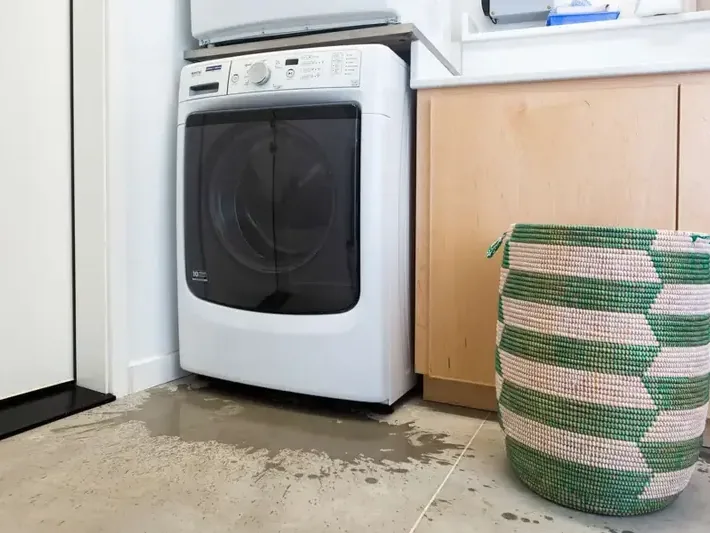
Lafayette has apartment and multi-family buildings ranging from 5 to over 40 units, and building of that kind has increased in recent years. In a stacked building, a leak that starts in one unit often shows up first as a ceiling stain in another.
Key takeaways
- Lafayette multi-family buildings range from 5 to over 40 units, so one leak can reach several households.
- About 61 percent of Lafayette housing units are single-family detached homes, so a leak behaves differently in a detached house than in a stacked building.
- The unit below usually sees the stain first, but the source can be the unit above, a shared wall or a building system.
- Shut off the appliance or the unit shutoff, tell the owner or manager in writing and photograph the damage in every affected unit.
- Drying has to cover the ceiling cavity, walls and floors of each affected unit, not only the one with the stain.
Why leaks travel in stacked buildings
In a stacked building, floors and ceilings are layers, and water follows gravity through every gap. A slow leak under a washer or a dishwasher can soak the subfloor before any stain shows below.
Once the water reaches the ceiling cavity of the unit underneath, it spreads sideways along joists and wiring. A stain in one room can hide wet insulation across several.
Lafayette has set aside a sizeable multi-family zoning area north and east of Good Samaritan Medical Center, and building of that kind has increased in recent years.
This is why a small leak in a kitchen can become a three-unit problem. The first stain is a clue, not the full picture.
Finding the source
The source is not always where the stain is. Finding it takes a short list of suspects.
Clues help. A stain that grows after a neighbor runs the washer points to a hose.
A stain that appears with no rain and no use of water may point to a pipe in the wall.
If the source is a shared pipe or a building system, the owner or manager takes over from there. The household above still helps by photographing what it saw.
- Washing machine hoses and the drain connection.
- A dishwasher supply or drain connection.
- An ice maker or refrigerator supply hose.
- A toilet supply connection or a failed wax seal.
- A water heater in a closet, or a shared pipe in a wall.
The first steps for each household
Both units have work to do in the first hours, and each depends on the other.
The unit below
The tenant or owner below sees the stain first. Photograph it, move belongings out of the path and tell the owner or manager in writing.
Do not wait to see whether the stain grows. A ceiling that holds water can fail without warning, and the room below it is the one at risk.
- Turn off power to a wet ceiling light or fan.
- Place buckets under active drips.
- Do not poke the stain, which can release a lot of water at once.
The unit above
The household above should shut off the appliance or the unit shutoff, stop using the fixture and wipe up standing water. They should also tell the owner or manager, in writing and with photos.
Leave the appliance alone once the supply is off. A repair can wait until the cause is understood and the adjuster has seen the part.
- Shut off the supply valve behind the appliance.
- Photograph the source, the floor and any wet cabinets.
- Keep the failed hose or part for the adjuster.
Who tells whom in a multi-family building
In a stacked building, the owner or manager controls the shared parts of the building. Written notice with a date and photos protects every household.
A manager can open adjoining units, shut off a building valve and call the right trades. Waiting for a verbal promise slows all three.
- The date and time the leak was found.
- The unit numbers involved.
- A short description of what happened.
- Photos attached, with the source and the stain both visible.
Drying across more than one unit
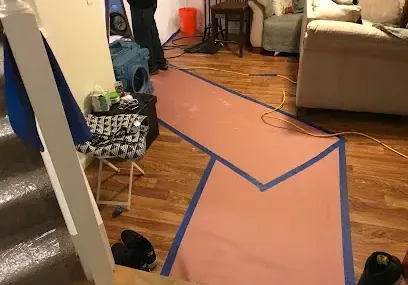
A leak that crosses a floor and a ceiling needs drying on both sides. Structural drying covers the ceiling cavity of the lower unit, the wall cavities between units and the subfloor of the upper one.
Moisture mapping shows how far the water spread, and the crew opens only what readings call for. Wet insulation and drywall that stay wet are removed.
Ceiling light fixtures and fans in a wet ceiling are a hazard, so the power to them is shut off first. A sagging ceiling is opened early, because the water inside has nowhere else to go.
- Ceiling drywall and insulation in the lower unit.
- Wall cavities near the plumbing wall.
- Subfloor and flooring in the upper unit.
- Cabinet bases and baseboards at floor level.
Single-family homes versus stacked buildings
About 61 percent of Lafayette housing units are single-family detached homes. In a detached house a leak stays within one household, so the owner makes every decision.
In a stacked building, an appliance leak water damage job often spans more than one household, more than one budget and more than one insurance policy.
Appliance leaks happen in both building types. What changes is who has to be told, who has to give access and how many households are affected.
Records for owners, managers and insurers
Photos, dates and a clear timeline help each party. The more complete the file, the faster the decisions.
More pages on other water problems are in the local water damage section.
Each household should keep its own copy. The unit below needs proof of what it lost, and the unit above needs proof of how fast it acted.
- Photos of the source and every affected unit.
- The date and time the leak was found and reported.
- The failed hose or part, kept for the adjuster.
- Moisture readings and the daily drying log.
Questions
How can a household tell where an apartment leak started?
The stain is rarely directly below the source. Moisture readings and a look at the appliances and plumbing in the unit above point to the origin.
Should a tenant or an owner call first?
Both should notify the owner or manager in writing, with photos, as soon as the leak is found. The manager can arrange access and shut off building valves.
Can a ceiling be dried without cutting it open?
Sometimes, if the water was clean and caught early. A ceiling that sags or stays wet is opened so the insulation and cavity can dry.
Does a leak in one unit always reach another?
No, but in stacked buildings it often does. Water follows gaps along pipes, joists and wiring, so a stain below is a reason to check above.
What should be kept after an appliance leak?
The failed hose or part, photos of the damage and a record of when the leak was found. The adjuster may ask for all three.
Who pays for drying in the unit below?
That depends on the lease, the building policy and the cause. The restoration team documents the loss, and owners, managers and insurers decide responsibility.