City Public Works has said Lafayette faces particular stormwater runoff and drainage issues in the Old Town area. Old Town is also home to dozens of houses from the late nineteenth century, so the same water reaches homes of very different ages.
Key takeaways
- More than 600 Lafayette homes date to before 1950, with dozens from the late nineteenth century in Old Town around Public Road.
- Runoff that reaches a house is treated as contaminated because it crossed streets, yards and gutters.
- Older homes can have wood floors, plaster and layers of past repairs, so the first step is to identify what each floor and wall is made of.
- Coal Creek and Rock Creek have city open space corridors, yet runoff damage often starts away from any creek.
- Photos and moisture readings taken early make later repairs and claims easier.
What City Public Works says about Old Town drainage
City Public Works has said Lafayette faces particular stormwater runoff and drainage issues in the Old Town area. That is a plain statement from the city, and it gives a household a reason to pay attention to where water goes.
The city also describes itself as a community that grew from coal-mining roots into a full-service city. Its older streets reflect that history.
Old Town sits along Public Road, where dozens of homes date from the late nineteenth century. Newer homes appear all around it.
Public Works statements are useful because they come from the people who manage the city's drainage. A household does not need a map of every pipe, only a habit of watching where water goes during a storm.
The housing mix is wide. About 61 percent of housing units are single-family detached homes, and mobile homes make up over 6 percent, so runoff meets many different kinds of structure.
Why older homes need a different first look
More than 600 Lafayette homes date to before 1950. About 70 percent of Lafayette homes were built between 1970 and 2000, so a single street can hold very different construction.
Materials vary from house to house
Older homes can have wood floors, plaster walls and layers of past repairs. Each reacts to water differently, and the crew identifies what each floor and wall is made of before choosing a method.
A wood floor that is cupping, a plaster wall that is bulging and a painted baseboard that is lifting each tell a different story about how long the water sat.
Even within one house, the floors can differ. A kitchen, a hallway and an added room may each have their own flooring, and each holds water in a different way.
Past repairs can hide water
A patched wall or a covered floor can hold water without any surface sign. A moisture meter and a thermal camera find what the eye cannot.
That is why readings are taken before any material is removed and again at each stage of drying.
Mixed construction on one street
A house from before 1950 can stand beside one built in the 1990s. Runoff reaches both, but the repair plans differ because the walls, floors and finishes are not alike.
That is why one neighbor may be drying a floor while another is replacing a wall.
When runoff reaches the house
Runoff rarely arrives all at once. It builds against a threshold, a wall or a window and finds the first weak point.
Because it crosses streets, yards and gutters, it is treated as contaminated. A full flash flood cleanup removes silt and wet porous materials before drying starts.
The safest rule is to treat any water that came from outside as dirty until a cleanup crew says otherwise. Skin contact, bare feet and children in the wet area are all worth avoiding.
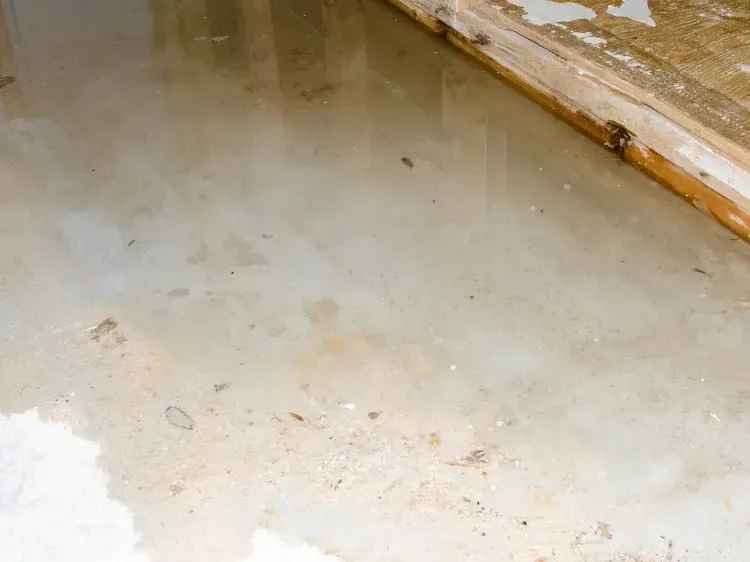
Runoff does not always show up as a puddle. Sometimes it seeps through a wall or the base of a door and appears only as a damp strip on the floor along the baseboard.
- Water pooling against a door threshold or a window well.
- Damp baseboards or flooring near exterior walls.
- Stains low on a wall that grow after rain.
- A floor that feels soft, cupped or uneven near an outside door.
Extraction, cleaning and drying
The first job is water extraction, because standing water keeps soaking into floors and walls. Pumps and extractors remove the volume, then the crew removes anything that cannot be cleaned.
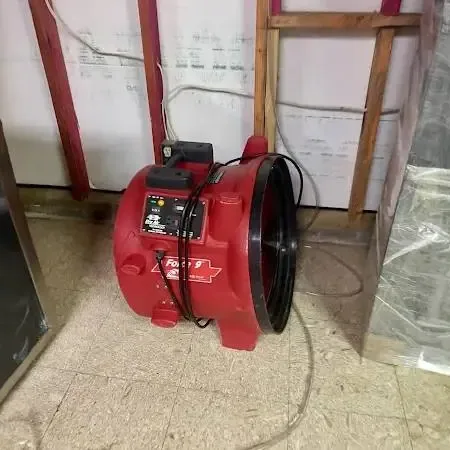
After cleaning, structural drying runs with air movers and dehumidifiers. Readings are taken every day and compared with a dry reference, so drying ends when the structure is dry, not when it looks dry.
Cleaning matters as much as drying. Silt left in a floor cavity can hold moisture and contamination long after the surface looks fine, so the crew cleans before it dries.
- Standing water extracted first.
- Silt, mud and soaked porous materials removed.
- Hard surfaces cleaned and treated.
- Framing, subfloor and walls dried to readings.
Creeks, open space and where runoff goes
Coal Creek runs through the city, and the city keeps an open space corridor and the Coal Creek Trail along it. Rock Creek is another city owned open space corridor.
A creek corridor is only one place water travels. Runoff damage often starts on an ordinary street, far from either creek.
The city keeps 20 community parks and 1,465 acres of open space. That is a lot of ground where water can soak in, and plenty of paved ground where it cannot.
Keeping runoff away from an older house
Most runoff problems are made worse by small things around the house. A short walk after a storm shows where the water went.
None of these steps replaces a repair, but together they reduce how often water reaches the foundation walls and doors.
- Clear gutters and extend downspouts so water lands away from the walls.
- Look for soil that slopes toward the house.
- Keep window wells clear of leaves and debris.
- Check the seal around doors and low windows before heavy rain.
Records and next steps
Photos of the waterline, the floor and any stained plaster help every later step. A short note with the date and the weather gives context.
The local water damage pages cover other causes of water in a home, from pipes to appliances.
If the same spot floods after each hard rain, note it. A pattern across several storms is more useful to a plumber, a landscaper or the city than a single event.
Questions
Does Lafayette have a stormwater problem in Old Town?
City Public Works has said Lafayette faces particular stormwater runoff and drainage issues in the Old Town area. The statement is general, so it does not name any one street or house.
Is runoff water clean?
No. It crosses streets, yards and gutters, so it is treated as contaminated and porous materials it soaked are removed.
Can an older wood floor be saved after water?
Sometimes. It depends on how long the water sat and what lies beneath, and moisture readings steer the decision.
Why do older homes need a different drying plan?
Their floors, walls and past repairs vary, so the crew identifies each material first and picks a method that fits it.
What should be photographed after runoff reaches a house?
The waterline, the floor near the door or window where water came in, and any stained plaster or lifted baseboard.
Do creeks cause most runoff damage in Lafayette?
Coal Creek and Rock Creek have city open space corridors, but runoff damage often starts on ordinary streets and yards far from either one.