Structural Drying in Louisville, CO
Wet framing, subfloor and wall cavities dry slowly, and the plan depends on how the building was built, from Old Town cottages to homes from the 1970s to the 1990s to newer townhomes. Readings, not guesses, end the job.
(888) 532-8620Call about drying the structure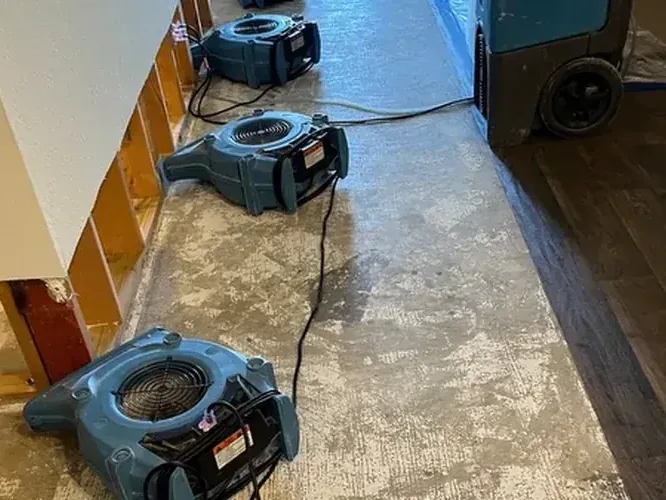
First steps for structural drying and dehumidification
- Classify the materialsWood, drywall and concrete are noted so the drying class is set correctly.
- Place the equipmentEquipment is sized to the room and positioned along wet surfaces.
- Monitor dailyReadings are repeated at marked spots and equipment adjusted.
- Confirm dryEquipment is pulled only after the readings match the dry reference.
How structural drying and dehumidification is handled, step by step
- 1
Classify
Materials and moisture levels are mapped.
- 2
Place
Air movers and dehumidifiers are set for the room.
- 3
Monitor
Readings are logged every visit and equipment adjusted.
- 4
Release
Equipment is removed once readings match normal.
What does structural drying and dehumidification cost in Louisville, CO?
Drying one to two rooms usually runs $1,200 to $3,500, a whole level $3,500 to $9,500, and dense materials or Class 4 drying $9,500 to $22,000 or more, because slow materials need longer equipment runs.
One to two rooms
- Local equipment setup
- Several days of drying
- Daily readings
Whole level
- Equipment in every room
- Cavities and floors dried
- Logged progress
Dense materials or Class 4
- Concrete or thick framing
- Specialty drying methods
- Extended run times
Ranges are typical, not a quote: the category of water, the square footage, the material class and how fast drying started move the number most. Run the water damage cost calculator for a closer planning range.
Reading the building before drying it
Drying a structure is slower than removing the standing water, and it is where most jobs succeed or fail. Wood, drywall and concrete release moisture at different speeds, so one setting never suits a whole building.
Local buildings are not alike. Old Town cottages and historic homes near Main Street, single-family neighborhoods from roughly the 1970s to the 1990s and newer infill homes all hold moisture differently, so the crew notes the structure before placing equipment.
- Material class Thin drywall dries faster than dense framing or concrete.
- Air movement Air movers are aimed to sweep wet surfaces and wall cavities.
- Humidity control Dehumidifiers pull moisture out of the air so it can keep drying the building.
Monitoring until the job is done
Readings are taken at the same marked spots every visit and compared with a dry reference from an unaffected area. Equipment is moved or removed as spots reach normal, and the log is kept for the owner and the adjuster.
Where structural drying fits
Drying follows every other water job, from water extraction to basement flooding cleanup, and it also stands alone when a hidden leak has wetted a wall that never showed standing water.
Further reading: Ready.gov flood safety and EPA WaterSense.
Structural drying and dehumidification across Louisville and nearby towns
The same service nearby: structural drying and dehumidification in Erie, Lafayette, Broomfield.
Structural drying covers ZIP codes 80027 and 80028, from Old Town and the Main Street area through the mature tree neighborhoods to newer townhomes, with commercial buildings on South McCaslin Boulevard.
Related water damage services in Louisville
Structural Drying and Dehumidification questions in Louisville
How long does structural drying take?
Most jobs need several days, longer for dense materials like thick framing or concrete.
Why do the machines run all day?
They must run continuously to keep pulling moisture out of materials. Turning them off lets humidity climb and slows the drying.
Can drywall stay if it dried?
If it stayed firm, was not contaminated and now reads dry, it can usually stay. Sagging or contaminated drywall is removed.
Is drying needed when no water is visible?
Yes. A hidden leak can leave framing and insulation wet with no puddle, and only a meter or infrared camera finds it.
Does the owner need to do anything during drying?
Keep the equipment running, follow the advice on doors and openings and report a machine that stops.
Wet walls or floors?
Crews set dehumidifiers and air movers, take daily readings and remove the equipment when the structure is dry. Call now, any hour.
(888) 532-8620Request a drying plan