Sewage Backup Cleanup in Louisville, CO
Sewage that rises through a floor drain or toilet is a health hazard, not a spill. Crews work in protective gear, extract the water, remove anything porous it touched and sanitize the area before drying begins.
(888) 532-8620Call about the sewage backup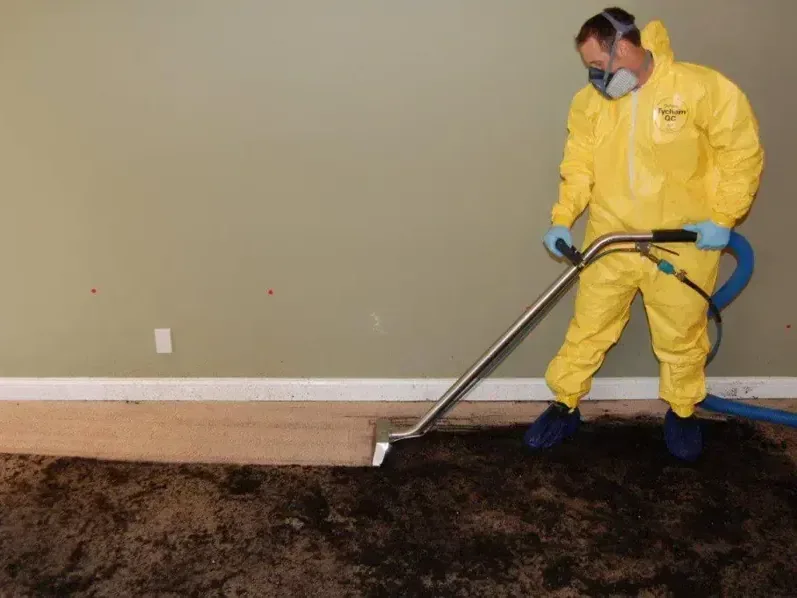
First steps for sewage backup cleanup
- Contain and protectProtective gear goes on and the affected rooms are isolated.
- Extract the waterPumps and wands remove the contaminated water.
- Remove and sanitizePorous materials are bagged out, then surfaces and framing are cleaned and treated.
- Dry and clearEquipment runs until readings are normal.
How sewage backup cleanup is handled, step by step
- 1
Protect
Gear on, rooms isolated.
- 2
Extract
Contaminated water is pumped out.
- 3
Sanitize
Porous items go and surfaces are treated.
- 4
Dry
Equipment runs once the area is clean.
What does sewage backup cleanup cost in Louisville, CO?
A small floor drain backup usually runs $2,000 to $5,000, a finished basement backup $5,000 to $15,000, and a large or long-standing backup $15,000 to $35,000 or more. Contaminated materials make removal a larger share of the cost.
Small floor drain backup
- Contained to one room
- Porous items removed
- Sanitizing and short drying
Finished basement backup
- Carpet and drywall removed
- Framing sanitized
- Several days of drying
Large or long-standing backup
- Contamination in several areas
- Extensive material removal
- Clearance readings
Ranges are typical, not a quote: the category of water, the square footage, the material class and how fast drying started move the number most. Run the water damage cost calculator for a closer planning range.
Who handles what
Sewage and drain backups carry bacteria and other contaminants, so they are handled as Category 3 water. Anything porous that the water touched is usually removed instead of cleaned, and the area is sanitized before drying begins.
City of Louisville Public Works oversees sewer pipes and wastewater treatment, and sewer and water repairs are among the permit types turned around by the next business day. The restoration crew does not decide who owns or must repair a private drain pipe, and it records the backup for whoever must act.
- Containment Affected rooms are isolated so contaminated air and water do not travel.
- Removal Carpet, pad, insulation and soaked drywall are bagged and discarded.
- Sanitizing Hard surfaces and framing are cleaned and treated before any drying starts.
Drying after sanitizing
Only after the area is clean do air movers and dehumidifiers run, so contaminated moisture is not pushed into clean rooms. Readings confirm that the framing and subfloor are dry, and clearance photos are saved for the owner and the adjuster.
When backups follow storms
Storm water can overwhelm a drain and bring sewage in with it, which links this work to flash flood cleanup. Clean supply water losses, by contrast, follow water extraction and do not need this level of protection.
Further reading: Ready.gov flood safety and Colorado Division of Insurance.
Sewage backup cleanup across Louisville and nearby towns
The same service nearby: sewage backup cleanup in Erie, Lafayette, Broomfield.
Sewage backup work covers ZIP codes 80027 and 80028, including Old Town, the Main Street and Front Street blocks, and the shops and restaurants along South McCaslin Boulevard and Marshall Road.
Related water damage services in Louisville
Sewage Backup Cleanup questions in Louisville
Is a sewage backup an emergency?
Yes. Contaminated water spreads bacteria across floors and into porous materials, so people and pets should stay out of the affected rooms.
Can a sewage backup be fixed by cleaning alone?
No. Cleaning removes the contamination, but the blockage behind the backup needs a plumber or the water will return.
Can carpet be saved after a sewage backup?
No. Carpet and pad are porous and cannot be made safe once sewage soaks them, so they are removed, while hard surfaces can be cleaned and sanitized.
Is the smell a sign of leftover contamination?
It can be. Odor often means contaminated material remains in a subfloor, wall cavity or insulation, so a visual check comes before the area is closed up.
Does insurance cover sewer backup?
Backup coverage is often a separate endorsement, so the policy should be checked early. The crew provides photos, readings and a material list that the adjuster can use.
Sewage on the floor?
Crews extract the water in protective gear, remove porous materials and sanitize the area. Call now, any hour.
(888) 532-8620Louisville sewage cleanup help